|
|
1.IntroductionThe skin is a heterogeneous organ made of tissues and layers that differ in morphology and molecular composition. The upper, epithelial tissue is the epidermis. The underlying dermis is a connective tissue. The dermis varies in thickness from . The thickness of covering epidermis can vary from up to on the palms and is stratified. The uppermost layers contain cornifying cells called corneocytes. As a whole, they make the thin horny layer called stratum corneum, the ultimate barrier between the organism and the external environment. Obviously, the stratum corneum (SC) plays a key role not only in protecting and preventing against external aggressions, but in regulating of water flux in and out as well. The stratum corneum ranges from thick, except for the palmo-plantar area, where it can be about ten times thicker. These functions are fulfilled by a unique structure consisting of 10 to 15 layers of flattened, anucleated, keratinized cells embedded in lipids matrix, such as “bricks in mortar”1 or more sophistically corneocyte cells surrounded by a 3-D multilamellar lipid domain.2, 3 In general, molecular composition of SC is: 75 to 80% fibrous protein (mostly in -keratin conformation),4, 5 5 to 10% lipids (ceramides, cholesterol, and fatty acids), and 5 to 10% of other materials (amino acids, NME, etc.).6 Several biophysical techniques have been developed during the last decade to improve skin description and knowledge, driven by medical, pharmaceutical, and cosmetic research.7 Vibrational spectroscopic techniques, such as infrared absorption and Raman scattering, are among such approaches that have emerged in this direction. Indeed, they give detailed information on molecular structure, composition, and microenvironment. Infrared (IR) absorption spectroscopy has been used for in vivo studies of stratum corneum hydration and permeability.8, 9, 10, 11, 12 However, due to the strong absorption of mid- and far-infrared radiation by water, the penetration depth in naturally hydrated tissue such as the skin is limited to a few microns. Therefore, in an in vivo IR-spectroscopic experiment, only the outermost layer of the stratum corneum is sampled. Raman spectroscopy is a complementary technique to infrared and provides molecular, structural, and compositional information of the sample. Nevertheless, in the confocal mode, it has the advantage of providing information from the surface of the skin down to several microns deep into the skin. This noninvasive and nondestructive technique can be operated without contact, does not require sample preparation, and shows great potential for the study of biological tissues. Early studies aimed at tissue characterization and pathological tissue classification, many of them targeting the skin.4, 13, 14, 15, 16, 17 The first in vivo studies of human skin using Raman spectroscopy were reported by Williams 13 Schrader, 15 and Shim and Wilson.16 The availability of in vivo confocal devices allowed enhancing in-depth measurements of the skin from the surface to several microns below the skin surface.17, 18, 19 This technique therefore provides a straightforward way to get more insights into the chemical structure and physical behavior of upper skin layers. This preliminary work was carried out on healthy individuals using a newly developed in vivo confocal Raman microprobe operating with an optic fiber and a laser. This probe permits acquisition of the spectrum over the whole frequency range from . Therefore, information about the fingerprint region and the higher frequencies containing water vibrations are collected simultaneously without using two different wavelengths as previously reported.19 Our study aimed at demonstrating the feasibility of the new probe in evaluating skin in vivo. Skin composition and structure variations were examined and discussed from in vivo Raman spectra of human skin from healthy volunteers. Data from several spots in the same area, variations between different anatomical sites, various volunteers, and different layers were compared. Skin hydration was also considered. 2.Material and Methods2.1.Experimental DeviceThe equipment included a fiber-coupled dispersive Raman spectrograph (InduRAM, Horiba Jobin Yvon, France) and a confocal Raman probe (Conf Head, Horiba Jobin Yvon, France). The objective used in this experiment was a long working distance lens (Olympus, Japan), with a numerical aperture of 0.5, operating in air. In our cosmetics application, it is necessary to work with this type of objective lens instead of an oil or water immersion lens, which is in contact with the skin. A piezo-electric device (Physics Instrument, Germany) allowed us to control high-precision axial translation of the lens throughout depth profiling from the surface down to a defined depth within the skin. This scanning device was directly controlled by the data acquisition software (LabSpec, Horiba Jobin Yvon, France), allowing automated depth profiling procedures. The excitation source was a He–Ne laser (Melles Griot, USA), delivering about at sample level. The spectrograph was equipped with an air-cooled CCD detector (Wright Instrument, UK), with a chip size of , and a grating, which allows the covering of a large spectral range from in a single shot acquisition with a spectral resolution of about , which is conserved at deeper regions. The acquisition time was about , which enabled us to perform rapid measurements at the surface as well as in deeper layers. A color video camera integrated within the probe enabled the user to visualize the sample in reflexion. Insertion of a density filter on the laser path allowed us to avoid any saturation of the camera due to the diffusion of the laser on the skin. The device also permitted us to visualize the attenuated laser spot focused on the sample, and therefore to achieve an accurate positioning of the laser on the sample. The compact design and the ease of handling the fiber optic probe also offer other possibilities such as access to other parts of the body, which stands as the very unique feature of this setup. The main sampling difficulties arising from in vivo conditions result from body movements, heart beat disturbances, and laser heating effects, which all affect the laser focal point. However, in the present case, the laser heating effects were negligible due to the low laser power at the sample level. To optimize the sampling conditions by limiting body motions and heart-beat-induced disturbances, the device was first stabilized using an inverted setup [see Fig. 1(a) ]. A schematic of the system to better understand the light path is illustrated in Fig. 1(b). The investigated part of the body was pressed against a holder, in which a small hole had been drilled to perform measurements. Hence, skin was flattened near the measured area so that large motions and therefore defocusing interferences were avoided. The interest of using a small aperture rather than a window placed between the lens and the sample (as reported by Caspers)19 not only lies in avoiding interferences of Raman features generated by the window material itself, but also in limiting the refraction index effects induced by an additional interface, which might affect the spatial and namely axial resolution. Data reproducibility was experimentally checked by recording ten successive spectra at the skin surface, showing very slight spectral features and intensity variations of less than 5% [see Fig. 1(c)]. Fig. 1(a) Picture of the in vivo confocal Raman fiber optic microprobe in the configuration for investigating the forearm. The mount contains a metal ring with a hole of about in diameter. This hole avoids or limits the motion of the subject during the measurements and thus stabilizes the whole system. (b) Representation of the schematic illustrating the light path of the system, (c) the reproducibility of the spectra, and (d) the axial resolution. The easy handling of this microprobe allows access to other parts of the body. 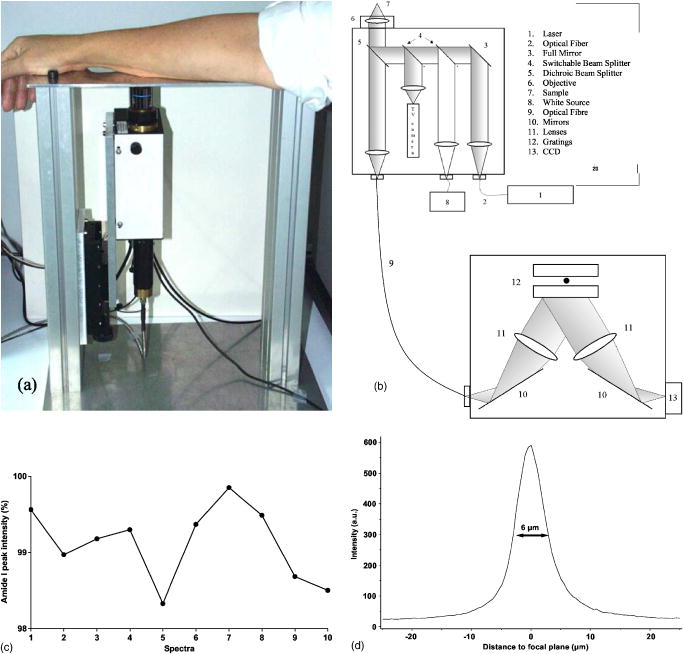 Visible light excitation at was preferred because quantum efficiency (and therefore sensitivity) of charge coupled device (CCD) detectors rapidly decreases above and becomes blind beyond . However, at , one benefits from the maximum sensitivity of such detection devices over the whole spectrum, giving optimal access to both low and high frequency regions, the latter being important for water content analysis. Nevertheless, using near-infrared (NIR) excitations may be of interest when facing fluorescence background interferences generated by applying cosmetic or pharmaceutical products on skin that turn out to be strongly fluorescent. Yet, one should bear in mind that going further to the infrared domain leads to weaker Raman scattering efficiency (as Raman intensity is directly proportional to ) and high power laser sources are thus required. 2.2.Determination of Axial ResolutionThe confocality principle is based on the selection of a restricted collection volume, often using a small aperture. This considerably improves lateral and depth resolution by filtering out the signal coming from out-of-focus or adjacent regions. Another advantage lies in a significant reduction of fluorescent background generated by the regions surrounding the laser focus point. These two advantages, namely high axial discrimination and fluorescence reduction, played a determining role in obtaining good quality Raman data, both from skin surface and from deeper layers. The depth of field of the objective used was directly related to the volume sampled and was determined experimentally. For this evaluation, a silicon sample was moved through the laser focus and the Raman collected signal was measured. Raman spectra of silicon were measured using the long working distance objective, at depth increments, from above the surface to in depth. The area of the Raman peak associated to the Si–Si vibrational mode at was plotted against the position of the laser focus, and the axial resolution was inferred from the full width at half maximum (FWHM) of this response curve. Under the conditions of the study, FWHM was found to be about . This is illustrated in Fig. 1(d). 2.3.SampleThe in vivo experiments were performed on seven healthy volunteers ( old), including two males and five females. The measurements were conducted at different anatomical sites: the fingertip (index, major, right and left hands), the thenar or palm, and the forearm. Before each measurement, the skin was cleaned with a single wipe of tissue soaked in 97% ethanol. For each individual and each site, three spectra from different points were averaged. The collection times varied about and depended on the subject. The spectra were measured at a range of depths below the skin surface with depth increments of for the profile of the arm and the hand. Considering the optical deconvolution and the oversampling, a step smaller than the axial resolution can be used. 2.4.Data Analysis2.4.1.Data preprocessingAll spectra were acquired and preprocessed according to the following scheme: linear baseline substraction (to get rid of the intrinsic skin fluorescence); and normalizing bands, respectively, at (which corresponds to the common band of lipids and proteins in the stratum corneum) for the range , and at for the range .14 The normalization is based on the integration of the area under the curve from and between . This normalization is scaled to have a standard deviation of 1. All these functions, together with the averaging procedure, were performed using the data acquisition software (LabSpec, Horiba Jobin Yvon, France). 2.4.2.Cluster analysisCluster analysis was performed on the average spectra collected from the same anatomical site of different subjects, using the fingerprint region . The spectral classification is based on the spectral characteristics of the skin available from different subjects. The result of the cluster analysis is a dendogram that was calculated using Ward’s algorithm and Euclidean distance available in the OPUS software (Bruker Optics, Wissembourg, France). 2.4.3.Curve-fitting of Raman spectraWhen the natural bandwidth is greater than the adjacent peak-to-peak separation, it is difficult to observe resolved features of overlapping Raman bands. The problem cannot be solved by increasing instrument resolution. To gain more insight into the overlapping structures, some mathematical processes can be applied to extract the hidden structural information from the spectra. Fourier deconvolution, second derivatives, and curve fitting are some of the currently used methods.20 The curve-fitting method was used on two spectral windows: and after area normalization and second derivative for the peak selection. The curve-fitting procedure used was based on a least-square method using Gaussian and Lorentzian bands.20 This procedure calculates a theoretical spectrum that best fits the experimental one. The accuracy of the fit is given by the chi-square value. The lower the value of the chi square, the better it fits.21 3.ResultsThe main spectral features of the human stratum corneum obtained with our fiber microprobe are assigned and described in Table 1 . No visual or spectral changes are observed during the measurements, which would indicate degradation or heating of the sample. The fiber optic probe operates with a laser and tests were conducted on healthy volunteers. We described earlier changes in in vivo Raman spectra between different spots of the same area, different anatomical sites, different individuals, and different skin layers. Table 1Raman assignment of the major vibrational modes for the human stratum corneum updated. δ=deformation ; ν=stretch ; ρ=rock ; str.=stretching . ∗ are revised bands. Values and assignments are resulted from this work and other literature reports.
3.1.Variations between Different Spots in the Same Site and Different Anatomical Sites in a Single SubjectFigure 2 shows in vivo Raman spectra of different spots of the fingertip (same site) from the same subject. Some variations of intensity can be noticed as well as slight changes in molecular composition. These variations concern amino acid composition, for instance at (tyrosine), at [ aromatic], and a NMF constituent [ vibration from the pyrrolidone-5-carboxylic acid (PCA)]. So, this analysis only reveals slight differences within the same site. Fig. 2Raman spectral variability between different spots of the same site: the middle finger tip. The time collection is . Intensity variations and slight molecular variations are observed in this case. Excitation wavelength , power at sample is . The spectra were recorded at the surface of the skin. 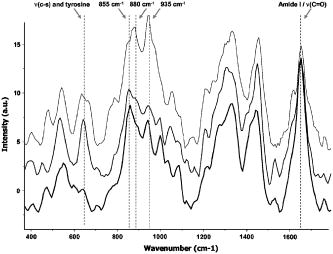 In vivo Raman spectra at different anatomical regions are shown in Fig. 3 . The spectra were recorded from the fingertip of the middle finger, the thenar (ball of the hand), and the volar aspect of the forearm. All spectra represent the average of several recordings per measurement spot. Site selection was made considering the ergonomics of the device, which means based on easy accessibility. Furthermore, the thickness and the functionality of the stratum corneum vary widely in tested areas. For example, the stratum corneum of the volar aspect of the forearm is very thin, about , whereas the stratum corneum of the fingertip or hand palm is much thicker (about ten times), due to the high frictional forces it has to withstand. In all the stratum corneum spectra extracted from various anatomical sites, we observed that the amide 1 and amide 3 vibrations are located around and , respectively, indicating the helical conformation of the major protein previously described for skin.22, 14 In addition, the presence of the variation around confirmed this observation (Fig. 3). The stratum corneum spectral signatures taken at different anatomical sites display several differences in the amide 1 region, the amide 3 region, and the band , the intensity of the bands 855 and . Fig. 3Comparison of mean spectra obtained at different anatomical sites: (a) fingertip, (b) thenar (ball of the palm of the hand), and (c) forearm. The time acquisition is per spectrum. (Average of three to six recordings per measurement point.) The spectra were recorded at the surface of the skin. 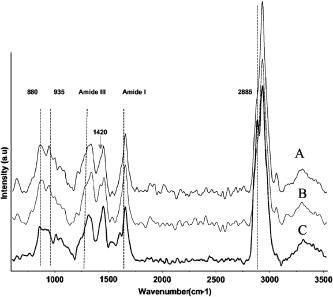 To provide further understanding concerning these variations, especially about the protein secondary structure, we have used a curve-fitting method to decompose the lamellar lipids region and the broad amide 1 band (Tables 2, 3 , and Fig. 4 ). Undeniably, in some cases there is an overlapping of the stratum corneum vibrations with another component such as, for instance, water with vibration around . Fig. 4Curve fitting of in vivo Raman spectra of skin in the frequency ranges (a) , and (b) . The black and gray lines represent respectively the experimental and calculated spectra. This spectral region is area-normalized to 100% for calculation of band areas (8 and 12 bands are used). The spectra were recorded at the surface of the skin.  Table 2Areas and assignments of bands resulting from curve fitting of in vivo Raman spectra in the frequency range 1600to1700cm−1 (amide 1 band). χ2=0.02*10−2 . The smallest χ2 , the better the deconvolution.
Table 3Areas and assignments of bands resulting from curve fitting of in vivo Raman spectra in the frequency range 730to1170cm−1 . χ2=7*10−4 . Assignment are referred to Refs. 4, 5, 17, 19, 24, 25.
3.1.1.Curve-fitting analysis of proteinThe analysis of the range , including the amide 1 band, reveals different secondary conformation of proteins [Fig. 4(a)]. In all three regions, the major protein of the stratum corneum, keratin, is mainly in an -helix conformation (forearm 38%; thenar 53%; fingertip 39%) (Table 2). This technique discloses another band of the protein at for the thenar (11%) and the fingertip (33%), which corresponds to the random coil conformation of the protein. However, this band is upshifted to higher frequencies in the forearm region, which determines the sheet nature of the protein conformation. We noted that the band of water is higher in the thenar region (18%) than in the forearm (10%) or the fingertip (6%) (Table 2). In accordance with the work of Byler and Susi,23 we can identify the low-frequency component around to “out of phase” beta-components of protein. At last, we identify the last band at , which is assigned to of aromatic amino acids (phenylalanine, tyrosine).24 3.1.2.Curve analysis of lipids and NMFWe use 12 bands for the curve fitting of this region [see Fig. 4(b)], which includes the characteristic band of lipids and amino acids as well (Table 3). The band , characterizing the vibration of lipids in disordered conformation, is two times higher in the fingertip region than the thenar (other region of the hand) or the forearm. Both bands at 1065 and describe the “trans” conformation of the lipids. Therefore, the lamellar lipids are in a crystalline phase liquid in the fingertip (disordered state), whereas they are in a gel phase (mixture of trans and disordered conformation) in the thenar and forearm regions. So, this state of organization is most probably related to the anatomical site of the body. Moreover, the contribution of the band around , which is assigned to aromatic of the tyrosine,4, 24, 25 is higher in all three regions. The spectral vibration around is attributed to a constituent of NMF, namely the pyrrolidone 5 carboxic acid.17, 19 The proportion of this component is quite similar in both the forearm and the fingertip, and is estimated to about 15%, whereas it is higher in the thenar (about 26%) (Table 3). The band is the highest in the forearm, ten times in comparison with the fingertip, while approximately two times than the thenar region. The band is higher (35%) and downshifted to in the fingertip. This latter corresponds to and olefinic (Table 3). The band assigned to of phenylalanine is the most important in the forearm. 3.2.Variations between Different Subjects in Analyzing the Same Skin AreaFigure 5 shows spectra obtained in the same area (fingertip) from four volunteers. We can note spectral changes between the different individuals in the whole range of frequencies concerning the lipid contents, NMF content, and amino acids. Using these differences, we performed a cluster analysis and the result is shown in Fig. 6 . The cluster analysis, shown by a dendogram, helps to highlight the differences observed between the different volunteers. For this approach, the averaged spectra from a fixed anatomical region have been used, namely the volar aspect of the forearm from seven volunteers. The volunteers were chosen with regards to their skin characteristics, which encompass a sampling from suntanned skin [Sub1(a), Sub1(b)] to a reddened skin (Sub7). The analysis was based on the fingerprint region, which includes the frequencies in the . This interesting approach allowed a separation of the spectra from the same site from different subjects, even close skin, for instance, Sub2 and Sub3 (Fig. 6). The threshold of heterogeneity indicates the degree of the similarity of the compared spectra. Fig. 6Cluster analysis of in vivo Raman spectra taken from the same anatomical site (left forearm) from different volunteers (Sub1 to Sub7). For the subject 1 (Sub1), we present also the right forearm [Sub1(b)]. We note two different groups with a heterogeneity level of 1.2. The analysis was performed on the range, the fingerprint region.  Fig. 5In vivo Raman mean spectra of the stratum corneum at the same anatomical site (fingertip), measured at the skin surface. The spectra are from four different volunteers (a) through (d). Time collection is about . The spectra were recorded at the surface of the skin.  On the other hand, we compared two close skins (visual selection) from two women aged about old, by analyzing different anatomical sites. The spectra were obtained at the fingertip, the thenar, and the volar aspect of the forearm. In both cases, the spectra were successfully classified according to the anatomical site (data not shown). 3.3.Variations between Different Skin LayersAnother important issue of this experiment was the depth profiling from the surface of the skin to a fixed depth. We investigated the spectral variations at different layers from the skin surface to approximately depth at the fingertip with a step of . Figure 7 displays only the in vivo spectra obtained with of increment. Fig. 7In vivo Raman spectra of the stratum corneum of the fingertip in the range. Raman spectra were recorded at different depths, starting from the skin surface down to below the skin surface. Numbers to the right of the spectra indicate this depth in . The spectra are intensity normalized (using the ) assigned to protein CH stretching mode. Signal collection time: per spectrum.  Spectral changes occurred, especially in the region between frequency range and around . The most prominent variations were seen in the bands at 885 and . Changes in water content were less conspicuous. In contrast, the depth profile of the forearm showed similar variations to the fingertip in the range, but also a strong increase in water content between skin surface and deeper (Fig. 8 ). Fig. 8Comparison of in vivo spectra obtained at the forearm at different depths: (a) , and (b) . The acquisition time is . An increase in water content is observed for . The comparison of the water content to deep into the skin is represented through a curve; the upper is about the forearm, whereas the lower concerns the fingertip. This ratio consists of OH (proteins).36 The error bars plotted represent 5% in the determination of the intensity ratio.  4.DiscussionIn this study, we demonstrated how the new confocal Raman microprobe is a powerful device for investigating molecular and structural skin composition in an in vivo and noninvasive way. Excellent Raman high-resolution skin spectra separate clearly the spectral variability between different spots of the same region, between different anatomical sites, intervolunteers, and between different layers. Barry, Edwards, and Williams,4 and Williams, 13 showed that there was only little variation in the spectra of the stratum corneum intra- and intercadavers. Gniadecka 14 demonstrated in vitro by Fourier transform (FT) Raman that protein conformation is changed in both chronologically aged and photoaged skin compared with young skin. They based their analysis on the amide 1, amide 3 (especially ), and band at . In our investigation, we distinguished from prior studies operating on the whole spectra range from . The in vivo human skin spectral features are in accordance with those described previously in the literature.4 This table has been updated by adding findings from other recent reports4, 19, 24, 25 (see spectral vibrations marked with an asterisk in Table 1). The spectral variation between different spots of the same body region (fingertip of same subject) was evaluated (Fig. 2). In agreement with Gniadecka, 14 the change in amide 1 band intensity is a consequence of water-protein interactions. Moreover, we have detected other spectral changes related to the band at , assigned to of aromatic of tyrosine, and which reveals a hydrophilic environment. Along these lines, we suggest that these changes are due to the presence of sweat, which is mainly composed of lactate (band at ) and urea that can modify the environment. Consequently, this Raman probe enables the detection of sweat and its effect on skin composition. Our analysis between different anatomical sites (fingertip, thenar, and forearm from same subject) showed differences in amide 1 and amide 3 , regions characteristic of keratin (major protein), which predominantly adopts an -helical conformation.4 More specifically, the results of curve fitting indicate the presence of different secondary protein conformation. We distinguish -helix conformation mostly at , sheet conformation featured at , and random coil configuration at . Moreover, the content of these different secondary structures varies following the anatomical site. Indeed, according to the curve fitting, the forearm presents a mixture of organized structures, namely 38% of helix and 26% of sheet (Table 2). In contrast, the fingertip region displays about the same amount of structured protein (39% -helix form) and unstructured protein form (33% random coil). These findings support the view that the proteins are more highly organized in the forearm than in the fingertip. The deconvolution of this amide 1 band also enhances the hidden vibration of the water bending mode around . The proportion of this band is clearly linked to the hydration of the stratum corneum of the anatomical site. Thus, the water content is about 18% in the thenar compared to 10% in the forearm and 6% in the fingertip (Table 2). We make evident here an inhomogeneous distribution of water, depending on the different anatomical sites. This allowed a better understanding of protein change, previously unexplained. The curve-fitting analysis of the reveals the lamellar organization of lipids in all studied anatomical sites (see Table 3). The bands at 1060, 1125, and are characteristic of ceramides 1 (major lipids component of the stratum corneum).3 The first two bands are attributed to the all-trans conformation (gel phase) of the acyl backbone in lipids, whereas the band at is mainly due to the gauche conformation (liquid crystal phase).26 This indicates markedly a lipid structure in a gel phase for the forearm and the thenar regions in contrast to a liquid crystalline phase in the fingertip region, which is a disorganized state. In addition, the intensity of the band at corresponding to asymmetric stretching of lipids is more prominent in the forearm than in other anatomical sites (Fig. 3). Thus, this feature suggests not only a qualitative difference in lipids content but a quantitative one as well, relevant to the anatomical site. NMF are known to be efficient humectants, especially in the stratum corneum layer.6 They comprise a highly water soluble and hygroscopic mixture of amino acids, and the major components are serine, PCA, and glycine.6, 27, 28 As described earlier, the intense band indicates a chemical hydrophilic environment of the tyrosine in the three analyzed regions. This provides additional insights into the behavior of different components of the skin, like tyrosine and lactate. The intensity change of the band at described as originating from glycine, serine, and alanine (constituent of the NMF) and that at (PCA of NMF),19 reveals that the NMF molecular composition of the stratum corneum varies according to the anatomical sites (Fig. 3). We established that different anatomical sites differ from their NMF constituent, lipids, and secondary conformation of proteins, which is in total agreement with the results obtained with different Raman systems and ATR-FTIR investigations.17, 29 Accordingly, the molecular variation of the stratum corneum is closely related to the physical properties of the skin. The forearm stratum corneum presents not only more organized proteins but also more organized lipids as well, compared to the fingertip stratum corneum. This better arrangement implies that the barrier function is more efficient within the forearm, despite its smaller thickness, than within the fingertip. Figure 5 exposed unequivocally similar variations of NMF components, lipids, and proteins between different individuals using measurements of the same region. The intersubject variations are explained partly by their lipid (ceramides 1) and protein contents.30 The protein variation results from different levels of maturation and natural hydration of the skin between different subjects. The observed NMF changes are consistent with a different state of the protein proteolysis pattern, the filaggrin protein being the main precursor of the NMF. Hence, NMF spectral features can be used as a biochemical marker to evaluate dry skin or the physical properties of the stratum corneum, as has been described by other methods.31, 32 The cluster analysis based on the spectral window allowed a classification of the spectra of the stratum corneum acquired at the volar aspect of the forearm from different volunteers. We distinguish two extreme cases in the dendogram33 related to the suntanned or matt skin [Sub1(a) and Sub1(b)] and the reddened skin (Sub7) (Fig. 6). This original approach can offer a quick and noninvasive way of classifying the skin in a given area and according to body area. The depth profiles of the stratum corneum were carried out from the surface to approximately deep in the fingertip (Fig. 7). Spectral variations were observed between and at the band (NMF). The water content of a fingertip does not vary from the surface of the skin to a depth of , because this region lies within the thickness of the stratum corneum at this site. In contrast at the level of the forearm, water content increases very quickly from the surface to about in-depth. This increase discloses the stratum corneum/stratum granulosum interface (Fig. 8),34, 35, 36 taking into consideration that the thickness of the stratum corneum is about for the forearm. Changes in water content according to the depth are associated with changes in the molecular composition of stratum corneum, especially regarding NMF and lipid contents.19, 29 5.ConclusionThis study clearly demonstrates the availability of the in vivo confocal Raman microprobe for rapid, noninvasive, and nondestructive molecular characterization of skin with respect to various anatomical sites, various layers (outermost and deeper) of the skin, and between individuals. Additionally, this probe reveals the water gradient from the surface to several microns below the skin surface. Thus, monitoring the percutaneous penetration of active molecules (drug, cosmetics), elucidating their interaction with skin components, their in vivo kinetics, and better understanding of the barrier function are feasible with this in vivo confocal Raman microprobe. Indeed, both qualitative and quantitative information are available. Further ergonomics improvement of the in vivo confocal Raman microprobe will offer an easier access to other anatomical sites, for example, leg, forehead, or cheek. With this point of view, a in vivo confocal Raman microprobe can generate useful information concerning the skin in pharmaceutical and dermatological approaches. The strong features of this probe are the widespread applications, the noninvasive and nondestructive aspects, and the flexibility of the ergonomics. ReferencesA. S. Michaels,
S. K. Chandrasekaran, and
J. E. Shaw,
“Drug permeation through human skin: Theory and in vitro experimental measurement,”
J. Am. Inst. Chem. Eng., 21 985
–996
(1975). Google Scholar
S. Grayson and
P. M. Elias,
“Isolation and lipid biochemical characterization of stratum corneum membrane complexes: implications for the cutaneous permeability barrier,”
J. Invest. Dermatol., 78
(2), 128
–135
(1982). 0022-202X Google Scholar
P. W. Wertz and
D. T. Downing,
“Glycolipids in mammalian epidermis: structure and function in the water barrier,”
Science, 217
(4566), 1261
–1262
(1982). 0036-8075 Google Scholar
B. W. Barry,
H. G. M. Edwards, and
A. C. Williams,
“Fourier transform Raman and infrared vibrational study of human skin: Assignment of spectral bands,”
J. Raman Spectrosc., 23 641
–645
(1992). https://doi.org/10.1002/jrs.1250231113 0377-0486 Google Scholar
A. N. C. Anigbogu,
A. C. Williams,
B. W. Barry, and
H. G. M. Edwards,
“Fourier transform Raman spectroscopy of interactions between the penetration enhancer dimethyl sulfoxide and human stratum corneum,”
Int. J. Clin. Pharmacol., 125 265
–282
(1995). 0300-9718 Google Scholar
A. V. Rawlings,
I. R. Scott,
C. R. Harding, and
P. A. Bowser,
“Stratum corneum moisturization at the molecular level,”
J. Invest. Dermatol., 103 731
–741
(1994). 0022-202X Google Scholar
H. Tagami,
M. Ohi,
K. Iwatsuki,
Y. Kanamaru,
M. Yamada, and
B. Ichijo,
“Evaluation of the skin surface hydration in vivo by electrical measurement,”
J. Invest. Dermatol., 75 500
–507
(1980). 0022-202X Google Scholar
D. R. Bommannan,
R. O. Potts, and
R. H. Guy,
“Examination of stratum corneum barrier function in vivo by infrared spectroscopy,”
J. Invest. Dermatol., 95 403
–408
(1990). https://doi.org/10.1111/1523-1747.ep12555503 0022-202X Google Scholar
K. Wichrowski,
G. Sore, and
A. Khaiat,
“Use of infrared spectroscopy for in vivo measurement of the stratum corneum moisturization after application of cosmetic preparations,”
Int. J. Cos. Sci., 17 1
–11
(1995). Google Scholar
F. Pirot,
Y. N. Kalia,
A. L. Stinchcomb,
G. Keating,
A. Bunge, and
R. H. Guy,
“Characterization of the permeability barrier of human skin in vivo,”
Proc. Natl. Acad. Sci. U.S.A., 94 1562
–1567
(1997). https://doi.org/10.1073/pnas.94.4.1562 0027-8424 Google Scholar
R. O. Potts,
D. B. Guzek,
H. H. Harris, and
J. E. Mckie,
“A noninvasive, in vivo technique to quantitatively measure of water concentration of the stratum corneum using attenuated total-reflectance infrared spectroscopy,”
Arch. Dermatol. Res., 277 489
–495
(1985). 0340-3696 Google Scholar
G. W. Lucassen,
G. N. A. Van Veen, and
J. A. J. Jansen,
“Band analysis of hydrated human skin stratum corneum ATR-FTIR spectra in vivo,”
J. Biomed. Opt., 3
(3), 267
–280
(1998). 1083-3668 Google Scholar
A. C. Williams,
B. W. Barry,
H. G. M. Edwards, and
D. W. Farwell,
“A critical comparison of some Raman spectroscopic techniques for studies of human stratum corneum,”
Pharm. Res., 10 1642
–1647
(1993). https://doi.org/10.1023/A:1018985006220 0724-8741 Google Scholar
M. Gniadecka,
O. F. Nielsen,
S. Wessel,
M. Heidenheim,
D. H. Christensen, and
H. C. Wulf,
“Water and protein structure in photoaged and chronically aged skin,”
J. Invest. Dermatol., 111 1129
–1133
(1998). https://doi.org/10.1046/j.1523-1747.1998.00430.x 0022-202X Google Scholar
B. Schrader,
B. Dippel,
S. Fendel,
S. Keller,
T. Lochte,
M. Riedl,
R. Schulte, and
E. Tatsch,
“NIR FT Raman spectroscopy-a new tool in medical diagnosis,”
J. Mol. Struct., 408/409 23
–31
(1997). 0022-2860 Google Scholar
M. G. Shim and
B. C. Wilson,
“Development of an in vivo Raman spectroscopic system for diagnostic applications,”
J. Raman Spectrosc., 28 131
–142
(1997). https://doi.org/10.1002/(SICI)1097-4555(199702)28:2/3<131::AID-JRS68>3.3.CO;2-J 0377-0486 Google Scholar
P. J. Caspers,
G. W. Lucassen,
R. Wolthuis,
H. A. Bruining, and
G. J. Puppels,
“In vitro and in vivo Raman spectroscopy of human skin,”
Biospectroscopy, 4 S31
–39
(1998). https://doi.org/10.1002/(SICI)1520-6343(1998)4:5+<S31::AID-BSPY4>3.0.CO;2-M 1075-4261 Google Scholar
P. J. Caspers,
G. W. Lucassen, and
G. J. Puppels,
“Combined in vivo confocal Raman spectroscopy and confocal microscopy of human skin,”
Biophys. J., 85 572
–580
(2003). 0006-3495 Google Scholar
P. J. Caspers,
G. W. Lucassen,
E. A. Carter,
H. A. Bruining, and
G. J. Puppels,
“In vivo confocal Raman microspectroscopy of human skin: noninvasive determination of molecular concentration profiles,”
J. Invest. Dermatol., 116
(3), 434
–442
(2001). https://doi.org/10.1046/j.1523-1747.2001.01258.x 0022-202X Google Scholar
P. R. Griffiths and
J. H. Haseth,
“A series of monographs on analytical chemistry and its applications,”
Chemical Analysis, 83
(1986) Google Scholar
G. Sockalingum,
W. Bouhedja,
P. Pina,
P. Allouch,
C. Mandray,
R. Labias,
J. M. Millot, and
M. Manfait,
“ATR-FTIR spectroscopic investigation of imipenem-susceptible and resistant pseudomonas aeruginosa isogenic strains,”
Biochem. Biophys. Res. Commun., 232 240
–246
(1997). 0006-291X Google Scholar
A. C. Williams,
H. G. M. Edwards, and
B. W. Barry,
“Raman spectra of human keratotic biopolymers: Skin, callus, hair and nail,”
J. Raman Spectrosc., 25 95
–98
(1994). 0377-0486 Google Scholar
M. Byler and
H. Susi,
“Examination of the secondary structure of proteins by deconvolved FTIR spectra,”
Biopolymers, 25 469
–487
(1986). https://doi.org/10.1002/bip.360250307 0006-3525 Google Scholar
A. Rodriguez-Casado,
S. D. Moore,
P. E. Prevelige Jr., and
G. J. Thomas Jr.,
“Structure of bacteriophage P22 portal protein in relation to assembly: investigation by Raman spectroscopy,”
Biochemistry, 40 13583
–13591
(2001). 0006-2960 Google Scholar
C. Xiao,
C. R. Flach,
C. Marcott, and
R. Mendelsohn,
“Uncertainties in depth determination and comparison of multivariate with univariate analysis in confocal Raman studies of a laminated polymer and skin,”
Appl. Spectrosc., 58
(4), 382
–389
(2004). 0003-7028 Google Scholar
G. S. Pilgram,
A. M. Van Pelt,
F. Spies,
J. A. Bouwstra, and
H. K. Koerten,
“Cryoelectron diffraction as a tool to study local variations in the lipid organization of human stratum corneum,”
J. Microsc., 189 71
–78
(1998). 0022-2720 Google Scholar
I. Horii,
K. Kawasaki,
J. Koyama,
Y. Nakayama,
N. Nakajima,
K. Okazaki, and
M. Seiji,
“Histidine-rich protein as a possible origin of free amino acids of stratum corneum,”
J. Invest. Dermatol., 10 25
–33
(1983). 0022-202X Google Scholar
J. Tabachnick and
J. H. Labadie,
“Studies on the biochemistry of epidermis. IV. The free amino acids, ammonia urea, and pyrrolidone carboxylic acid content of conventional and germ-free albino guina pig epidermia,”
J. Invest. Dermatol., 54 24
–31
(1970). 0022-202X Google Scholar
L. Brancaleon,
M. P. Bamberg,
T. Sakamaki, and
N. Kollias,
“Attenuated total reflection-Fourier transform infrared spectroscopy as a possible method to investigate biophysical parameters of stratum corneum in vivo,”
J. Invest. Dermatol., 116
(3), 380
–386
(2001). https://doi.org/10.1046/j.1523-1747.2001.01262.x 0022-202X Google Scholar
L. Knudsen,
C. K. Johansson,
P. A. Philipsen,
M. Gniadecka, and
H. C. Wulf,
“Natural variations and reproductibility of in vivo near-infrared Fourier transform Raman spectroscopy of normal human skin,”
J. Raman Spectrosc., 33 574
–579
(2002). https://doi.org/10.1002/jrs.888 0377-0486 Google Scholar
J. Koyama,
I. Horii,
K. Kawasaki,
Y. Nakayama,
Y. Morikawa, and
T. Mitsui,
“Free amino acids of stratum corneum as a biochemical marker to evaluate dry skin,”
J. Soc. Cosmet. Chem., 35 183
–195
(1984). 0037-9832 Google Scholar
N. Nakagawa,
S. Sakai,
M. Matsumoto,
K. Yamada,
M. Nagano,
T. Yuki,
Y. Sumida, and
H. Uchiwa,
“Relation ship between NMF (lactate and potassium) content and the physical properties of the stratum corneum in healthy subjects,”
J. Invest. Dermatol., 122 755
–763
(2004). 0022-202X Google Scholar
C. Sandt,
G. D. Sockalingum,
D. Aubert,
H. Lepan,
C. Lepouse,
M. Jaussaud,
A. Leon,
J. M. Pinon,
M. Manfait, and
D. Toubas,
“Use of Fourier-transform infrared spectroscopy for typing Candida albicans strains isolated in intensive care unit,”
J. Clin. Microbiol., 41
(3), 954
–959
(2003). 0095-1137 Google Scholar
T. Von Ziglinicki,
M. Lindberg,
G. M. Roomans, and
B. Forslind,
“Water and ion distribution profiles in human skin,”
Acta Derm Venereol, 73 340
–343
(1993). 0001-5555 Google Scholar
R. R. Warner,
M. C. Myers, and
D. A. Taylor,
“Electron probe analysis of human skin: determination of the water concentration profile,”
J. Invest. Dermatol., 90 218
–224
(1988). 0022-202X Google Scholar
N. J. Bauer,
J. P. Wicksted,
F. H. Jongsma,
W. F. March,
F. Hendrikse, and
M. Motamedi,
“Noninvasive assessment of the hydration gradient across the cornea using confocal Raman spectroscopy,”
Invest. Ophthalmol. Visual Sci., 39 831
–835
(1998). 0146-0404 Google Scholar
|